

Vijay Pratap Singh
13 Oct 2026
Beneath Shivling and Meru: Trekking the Gaumukh-Tapovan Trail
Where the Ganga Begins, and Where Climbing History Was Written
Gangotri National Park is one of the few places in the Himalaya where a trekker and a world-class alpine climber share the same trail for the first three days. Both start at the same glacier, cross the same boulder fields, and look up at the same granite spires. Then the climber keeps going into some of the hardest big-wall terrain on earth.
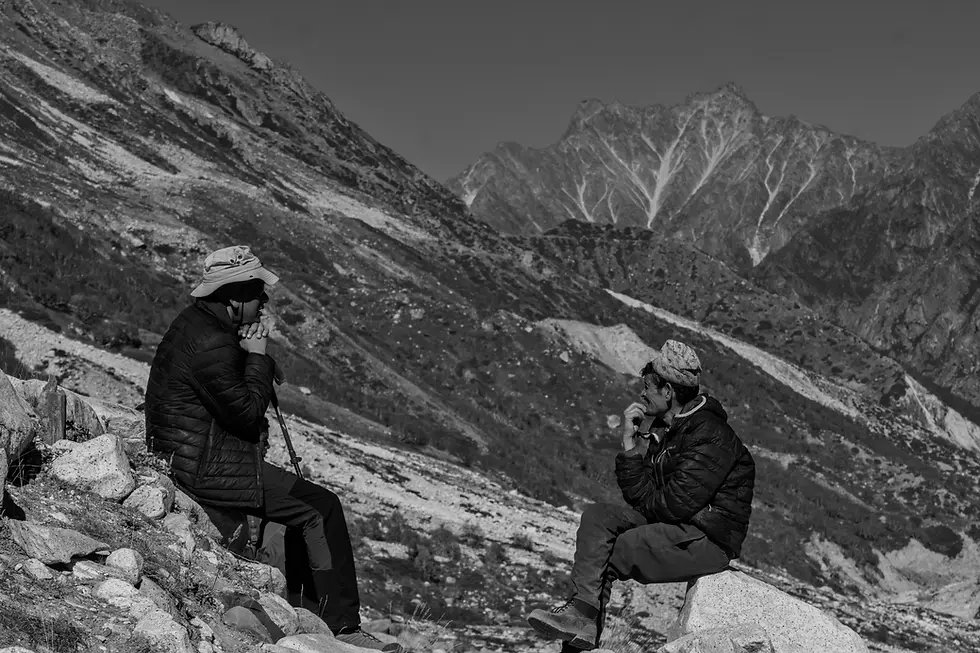
The scale is the first thing you notice. On the moraine slopes above the Bhagirathi valley, a group of trekkers shrinks to a few coloured dots between house-sized boulders. Every step is a small puzzle of loose rock, and every pause reveals another snow-fluted summit against a hard, cloudless October sky.
This is the Gaumukh-Tapovan trek, the classic Gangotri Glacier trek in the Garhwal Himalaya of Uttarakhand. It leads to the snout of the glacier that feeds the Bhagirathi, the headstream of the Ganga. It also leads to Tapovan, the high meadow that sits directly beneath Shivling and serves as the gateway to the Meru group, made famous worldwide by Jimmy Chin's film Meru.

The Meru Effect: How a Film Put Gangotri on the Global Climbing Map
Gangotri's reputation among serious climbers rests on one line of rock: the Shark's Fin on Meru Central (6,310 m). In 2008, Conrad Anker, Jimmy Chin and Renan Ozturk attempted the route and turned back just short of the summit. In 2011 they returned and completed the first ascent, a landmark in modern Himalayan mountaineering.
The 2015 documentary Meru, directed by Jimmy Chin and Elizabeth Chai Vasarhelyi, told that story of failure, injury, grief and persistence. It won the Audience Award at Sundance and introduced millions of viewers to the granite headwall above the Meru Glacier.
The film changed how the world sees this region. Climbers who once knew Gangotri only from the Bhagirathi group and Shivling now ask about Meru Peak, the Shark's Fin and alpine-style climbing in the Garhwal Himalaya. Trekkers who would never attempt the wall still walk to Tapovan to see it.
What the film also showed is why the area matters technically. The Shark's Fin combines high altitude, cold granite, thin ice and long committing pitches, and it is reached only after a glacier approach. It is a reminder that the best technical climbing in the Himalaya is often found in compact, hard-to-reach cirques like this one, not on the famous eight-thousanders.

Technical Highlights: Peaks, Glaciers and Passes of Gangotri National Park | Gaumukh Tapovan trek
Gangotri National Park was established in 1989 and covers roughly 2,390 km² in Uttarkashi district, Uttarakhand. It protects the catchment of the Gangotri Glacier, about 30 km long and one of the largest glaciers in the Indian Himalaya. Its snout at Gaumukh (about 3,892 m) is the source of the Bhagirathi River.
The park is ringed by granite and ice peaks, most between 6,000 m and 7,000 m. Heights below are approximate and vary slightly between surveys.
Peak | Height (m, approx.) | Why climbers care |
Shivling | 6,543 | The "Matterhorn of India"; a steep pyramid above Tapovan with a demanding technical ascent |
Meru Central (Shark's Fin) | 6,310 | Sheer granite headwall; first climbed in 2011 |
Meru North / Meru South | 6,450 / 6,660 | Neighbouring summits in the Meru group above the Meru Glacier |
Bhagirathi I / II / III | 6,856 / 6,512 / 6,454 | Granite and ice routes favoured by alpine-style climbers |
Thalay Sagar | 6,904 | Steep, committing and technical |
Bhrigupanth | 6,772 | Remote peak near the Kalindi Khal route |
Kedardome | 6,831 | Dominates the Kedartal trek |
Satopanth / Chaukhamba I | 7,075 / 7,138 | Seven-thousanders on the park's edge |

Glaciers: the Gangotri, Meru, Raktvaran and Chaturangi glaciers form a connected network. Crevasse hazard, moving debris and rockfall are real, so glacier travel skills matter.
High passes and extension treks: Kedartal, Nandanvan and Vasuki Tal, and the high Kalindi Khal pass (about 5,950 m), which crosses to Badrinath and demands glacier experience, fixed-rope skills and good acclimatization.
Terrain you will meet:
Giant glacial moraine and loose boulder fields
Crevassed glacier travel
Granite big walls and mixed ice-and-rock faces
High alpine meadows at Tapovan and Nandanvan
The Route: Gangotri to Gaumukh to Tapovan
The standard Gaumukh-Tapovan trek takes about 5 to 6 days and gains roughly 1,400 m from the road head to the high meadow. Distances and altitudes below are approximate.
Gangotri (about 3,100 m): the temple town and trek start. Spend a day here to acclimatize and complete permit checks.
Gangotri to Bhojbasa (about 14 km, 3,792 m): a steady trail through pine and bhojpatra (birch) forest, passing Chirbasa. The valley widens and Shivling and the Bhagirathi peaks start to appear.
Bhojbasa to Gaumukh (about 5 km, 3,892 m): the trail crosses loose moraine to the glacier snout, where the Bhagirathi emerges from the ice.
Gaumukh to Tapovan (about 6 km, 4,400 m or higher): the hardest day. Trekkers cross the glacier and climb unstable boulder slopes to the meadow, with Shivling rising directly above camp.
Tapovan and back: rest and explore. Experienced parties continue toward the Meru Glacier and base camp, then descend to Gangotri.
The moraine section between Gaumukh and Tapovan is what separates this trek from a simple valley walk. The slopes are steep, the boulders shift, and the group often has to move one at a time with trekking poles. Good boots, a steady pace and a guide who knows the line make a real difference.
Why Gangotri Is One of the World's Great Trekking and Climbing Destinations
Climbers from around the world come to Gangotri because few places combine so much in so little space.
Sacred and wild at once. The source of the Ganga is both a pilgrimage site and a high-alpine wilderness.
A trek that serves two audiences. Trekkers can reach Gaumukh and Tapovan, while expert climbers use the same approach to attempt some of the hardest walls in the Himalaya.
Granite and glacier. Clean granite architecture rises above long glaciers, a combination more often associated with Patagonia or the Alps than the Himalaya.
Stable post-monsoon weather. September and October often bring deep blue skies and crisp visibility, ideal for both photography and climbing.
A compact cirque of serious objectives. Shivling, the Meru group, the Bhagirathi peaks and Thalay Sagar are all within a few days of each other.
Dramatic changes of scale. A single frame can hold a trekker, a boulder the size of a house and a 6,500 m summit.
Conservation value. The park protects the Gangotri Glacier system and wildlife such as Himalayan blue sheep and tahr, with snow leopard habitat in the higher valleys.
Managed access. Permit limits help keep the trail wild and the experience uncrowded.
For climbers who want high-altitude trekking in India that leads naturally into real Himalayan expedition terrain, Gangotri is hard to match.

Planning Your Trip: Season, Permits, Acclimatization and Safety
Item | Detail |
Best season | May to June and September to mid-October |
Typical duration | 5 to 6 days for Gaumukh-Tapovan |
Maximum altitude | About 4,400 m or higher at Tapovan |
Difficulty | Moderate to challenging, mainly because of altitude and moraine |
Permits | Required from the Uttarkashi forest authorities; daily numbers are capped |
Start point | Gangotri, reached by road from Uttarkashi |
Permits. Entry to Gangotri National Park needs a forest department permit, and the daily number of trekkers is limited. Rules and quotas change, so confirm current requirements with the Uttarakhand Forest Department or your trek operator before you travel.
Acclimatization. Spend at least one night around Gangotri or Uttarkashi before starting. Climb gradually, drink plenty of water and add a rest day at Bhojbasa or Tapovan if anyone shows signs of altitude sickness.
Safety. Use trekking poles for the moraine, start early to avoid afternoon rockfall and weather changes, and never cross glacier terrain without a guide. Carry a first-aid kit, sun protection and layers for temperatures that drop sharply at night.
Packing essentials. Broken-in trekking boots, a warm insulated jacket, a sun hat, sunglasses with UV protection, a windproof shell, gloves, a headlamp and a refillable water bottle.

AdvenThrill's Vision: New Challenges for Climbers Who Want More
At AdvenThrill, we believe the best peaks are the ones that ask something new of you. Gangotri is full of them: unclimbed lines, lesser-known summits, high glacial passes and technical walls that reward preparation, teamwork and respect for the mountain.
Our vision is to explore these peaks with climbers who love finding new challenges. That means:
Expeditions built around your goals, from a first high-altitude trek to Tapovan, to a technical objective in the Bhagirathi or Meru groups, to a crossing of Kalindi Khal.
A team of climbers, not just guides. Our people have the field experience to read terrain, weather and group strength, and to help you choose the right objective.
Responsible adventure. We aim to leave these glaciers, meadows and trails as wild as we found them, in a park that protects the source of the Ganga.
Room to grow. Whether you are stepping up from trekking to mountaineering or planning your next alpine-style push, we help you build skills step by step.
Plan your Gangotri adventure with AdvenThrill
If you are thinking about Shivling, the Meru group, the Bhagirathi peaks or a first trek to Gaumukh and Tapovan, talk to our team of climbers. Tell us your experience, your dream line and your timeline, and we will help you shape the expedition.
Contact AdvenThrill >> Contact Us
Related Articles:
Trekking & Mountaineering in Uttarakhand in 2027 with Adventhrill
Everest Base Camp Trek Cost : A Complete Price Breakdown
Roopkund Trek Reopened: Exploring the Mysteries of Uttarakhand’s Skeleton Lake Adventures